






 English
 Français
 Deutsch
 Italiano
 Português
 Русский
 Español
 Svenska
 ไทย
ไทย Türkçe
 हिन्दी
 Filipino
 简体中文
简体中文 한국어
한국어 Polski
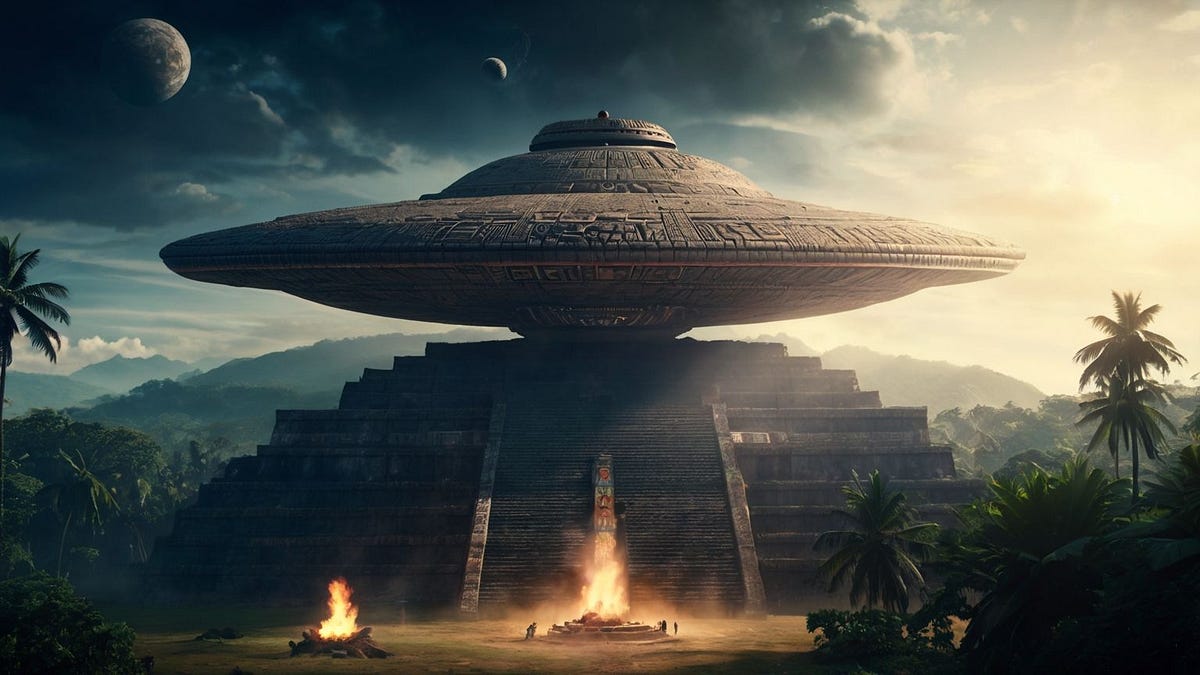
The existence of UFOs or UAPs has been a long-standing enigma, with questions as to how these objects could have reached Earth through interstellar travel and why they are present here and now despite the vastness of cosmic space and time.
Interestingly, ancient Indian writings mention flying machines called “vimanas,” leading some to wonder if these could be the relics of what we now call UFOs or UAPs.
Regarding Earth’s history, the Paleozoic Era, which lasted from 541 to 252 million years ago, was a significant time for the development of life on our planet. It was marked by the Cambrian explosion, which saw Earth’s most important event in diversifying life forms. This era also saw the emergence of fish, lush rainforests, and the transition of amphibians to dry land.
The Paleozoic Era, a period of great biological diversity and evolution, ended with a catastrophic global event — the Permian-Triassic extinction. This event was responsible for wiping out more than 80% of all marine species and 70% of terrestrial vertebrate species, which has never been seen before in Earth’s history. The extinction caused the burial of plants and swamps, eventually turning into coal deposits. It is believed that the cause of this event was due to volcanic eruptions that created the Siberian Traps. However, the global warming event that triggered the extinction was caused by industrial pollution from a technological civilization that existed 252 million years ago.
Although it may seem unlikely, an intelligent civilization could have emerged just 6% earlier in Earth’s history. Any technological infrastructure left on the planet’s surface by that early civilization could have been destroyed by geological activity, including subduction, covered by water, or damaged by meteorite impacts and erosion. Nevertheless, artifacts from that civilization could have been preserved in space.
Over the last century, advancements in modern technology have enabled our civilization to launch thousands of functional devices into orbit. However, a more advanced or longer-lived technological civilization may…
Read the full article here