






 English
 Français
 Deutsch
 Italiano
 Português
 Русский
 Español
 Svenska
 ไทย
ไทย Türkçe
 हिन्दी
 Filipino
 简体中文
简体中文 한국어
한국어 Polski
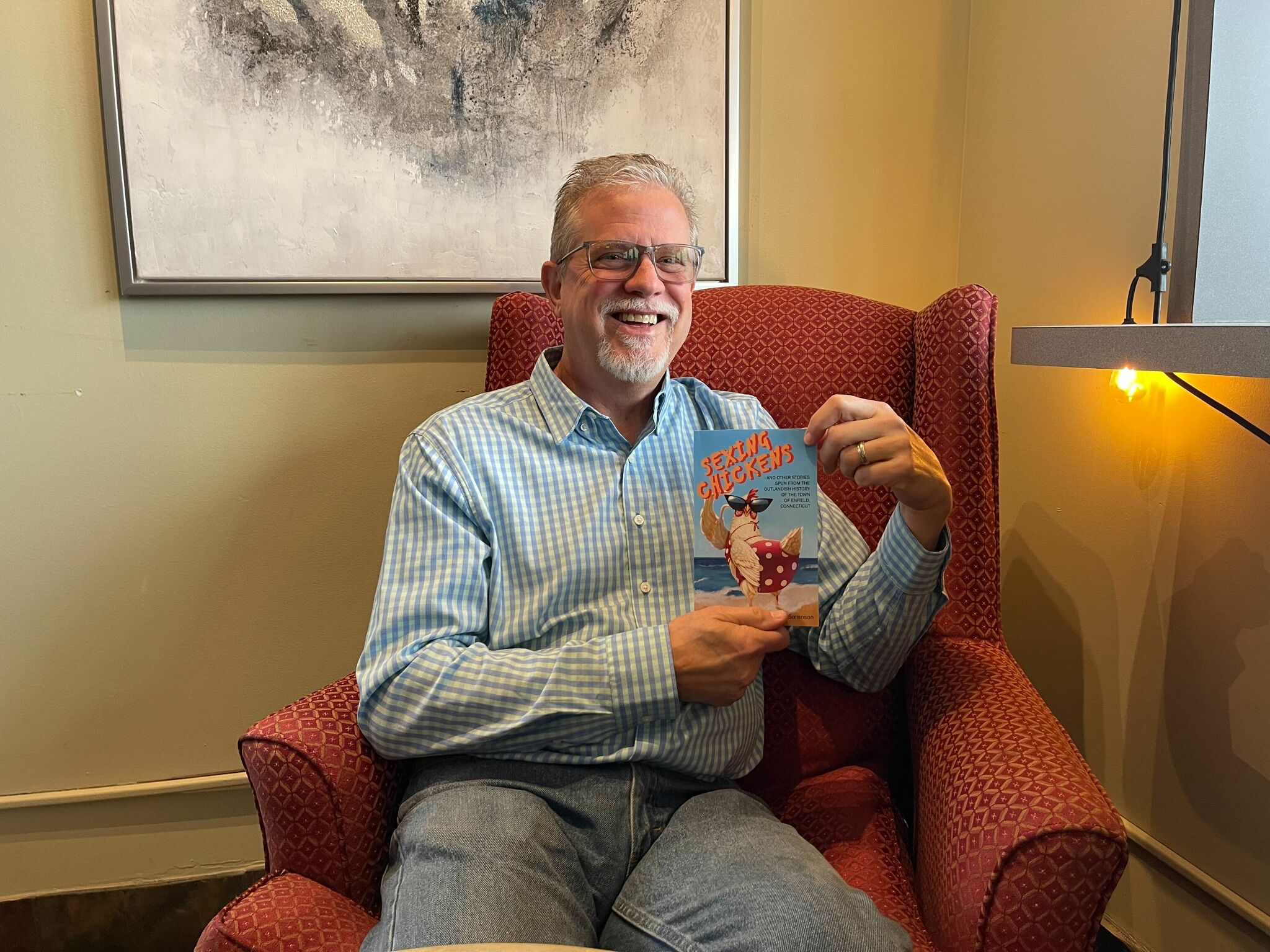
ENFIELD — UFO sightings at a prison farm? A spirit that haunts a lakeside home? These might sound like tall tales, but they are part of the unusual history and events that have shaped Enfield.
And it’s possible that few residents, if any, knew about the town’s quirky history until Peter Floyd Sorenson moved to the community five years ago.
The author and president of the Enfield Historical Society has uncovered numerous tales in his latest book, “Sexing Chickens and Other Stories Spun From the Outlandish History of the Town Of Enfield, Connecticut.” The 299-page book consists of 12 tales about events or individuals unique to the town and villages of Thompsonville, Scitico, and Hazardville.
Included in the book are stories about Sugar Ray Robinson, who fought as an amateur in an 3,500-seat outdoor boxing arena in Thompsonville; 19-year-old Carlo DeCaro, who was one of the last people put to death in the electric chair in Connecticut for the murder of his neighbor on their way to work in Somersville; a UFO sighting at the Osborne Prison Farm; the forgotten history of vigilante protection group the Enfield Society for the Detection of Thieves and Robbers with a new proposed date for its inception; and the long-deceased Elder Shaker George W. Clark, whose spirit reportedly visits a house on the banks of Shaker Pines Lake.
The most interesting aspect in the research process, Sorenson said, is that so many residents of his “adopted” town have never even heard of the stories.
“Enfield is rich with the kind of stories other towns can only dream about,” he said. “For someone like me, the town is a playground filled with endless stories to research and in which to immerse myself.”
Sorenson said stories he learns — or snippets of them — come from things he reads and hears or during conversations he has with people in town. “Clues lead to other clues,” he said. “Putting the pieces together is what I love about being a historian.”
The strange title of his book comes from the story of Chester Pilch, who lived most of his life in Enfield. In high school, he joined the 4-H Club, where he became interested in chickens and bought 200 chicks, raised them, and ultimately sold them for a profit.
“He wasn’t very intellectual but developed the skill of determining the sex of chickens,” Sorenson said. “It’s a highly sought-after skill for farmers who want hens or roosters.” That ultimately led to Pilch’s breeding program that produced chickens bred for rapid weight gain.
Pilch became the second-largest breeder of chickens in the world. His business was headquartered in Hazardville and included farms in four states, as well as Mexico, Ireland, and Canada.
Pilch’s story ended sadly, Sorenson said, when he ran up against resistance from town officials. He wanted to revitalize Thompsonville after the departure of W.T. Grant in 1965 and proposed a chicken hatchery in the vacant space. Town Planner William Kweder, however, objected to the proposal, ultimately causing Pilch to open the hatchery in North Carolina, laying the groundwork for him to eventually leave Enfield.
Sorenson’s research also revealed the town’s appeal to people from far and wide, including actor, singer, and activist Paul Robeson. He bought property, known as The Beeches, in Thompsonville on April 1, 1941, where he moved with his family. Sorenson notes that several local newspapers, such as the Meriden Daily Journal, made much of Robeson’s race in their reporting of the sale, as well as the disrepair of the house, which had its own bowling alley and outdoor swimming pool.
Robeson made his first public and surprise appearance in town on June 18, 1941 at Enfield High School Class Day exercises. After an introduction by principal Karl Lee, he sang four songs for the audience, including a rendition of “Ole Man River.”
He and his family lived in Enfield for 12 years, where Robeson gave annual concerts on behalf of the Enfield Teachers’ Association’s child health program, which came to be known as the Paul Robeson Child Welfare Fund.
“Sexing Chickens” is Sorenson’s third book about local history, following “Climax Fuse: The Explosive History of Ensign-Bickford” and “Hazard Powder: The Powder Hollow Explosion of 1913.”
He said “Sexing Chickens” is written for a “the 21st-century mind set” that may not be used to reading more than snippets of information at one time. The relatively short chapters can be read “in one sitting without a huge time commitment,” he said.
Sorenson is already thinking about his fourth book that will be about Thompsonville. For now, though, he said he’ll concentrate his efforts on marketing for this recent book, which is for sale through Amazon and Barnes & Noble.
He will be signing copies of his books at the Barnes & Noble in Enfield Commons on Dec. 2 from 1 to 4 p.m.
Read the full article here