





 English
 Français
 Deutsch
 Italiano
 Português
 Русский
 Español
 Svenska
 ไทย
ไทย Türkçe
 हिन्दी
 Filipino
 简体中文
简体中文 한국어
한국어 Polski
The Sky Canada Project “Preview Report”
The Office of the Chief Science Advisor for Canada (OCSA) has published its first report on the Sky Canada Project. It had been delayed several months, having been scheduled originally for the fall of 2024. News came in December 2024 that it would be published in two parts in 2025, the first being an executive summary plus recomendations, and the body of the report later in the year.
It contains a “Message from the Chief Science Advisor of Canada,” Dr. Mona Nemer, and an Executive Summary. These are followed by two appendices, the first being a list of contributors and experts consulted (including me) and the second, the results of a survey of Canadians by an outside agency, regarding opinions on UAP.
No, it was not “Disclosure,” as some UAP media darlings had claimed. In fact, I’m fairly sure that most UFO fans will be disappointed with the report, as it does not contain details of a single UAP case, names of whistleblowers, or locations of crashed UFOs.
[Which is not surprising to anyone who studies ufology beyond sensational claims on social media.]
In fact, OCSA made that clear several times, including on its website, which even had a Disclaimer at the top of the page:
Disclaimer
It should be noted that the Sky Canada Project is not intended to access and collect first-hand data (like photos, testimonies, etc.), nor is it intended to make the OCSA the main point of contact for Canadians wishing to report observations or personal experiences. Furthermore, it is not meant to prove or disprove the existence of extraterrestrial life or extraterrestrial visitors.
Instead, the Sky Canada Project was designed to look at what has been done about UAP within the Canadian government, and how that approach is working. It’s essentially laying the foundation for a pretty decent major study of UAP, perhaps better than the Colorado Study.
The Sky Canada Project was launched in the Fall of 2022 to study how Unidentified Aerial Phenomena (UAP) reports from the public are managed in Canada and to recommend improvements.
There’s nothing in there about Disclosure.
What is in the report, then? Nemer lays this out in her Message:
Our goal was to find the
current resources and processes in place for handling and following up on UAP
reports, to compare them with the best practices in other countries, and to
make recommendations for potential improvements. Accordingly, this report
focuses on the services available to the Canadian public for reporting UAPs,
and not on the UAPs themselves; understanding this distinction is critical to
reading the report. The Sky Canada Project is not about investigating what UAPs
are. It is about science informing and serving everyone.
The study explores the
current reporting landscape, identifies gaps, and provides recommendations to
enhance transparency and scientific inquiry on UAP issues in Canada.
In other words, Nemer’s team wanted to know what was being done about UAP in government departments and make recommendations for what should be done to improve the situation. (i.e. lots)
The emphasis was on taking a scientific approach, even calling on the Canadian scientific community to take a more active role in studying UAP. In particular, the Canadian Space Agency was suggested as a hub for UAP research. (As if.)
She went on:
The Sky Canada Team
gathered information from federal departments and agencies, stakeholders,
experts, and other organizations, on how UAP observations reported by the
public are handled in Canada.
We also examined publicly
available records such as historical UAP data, as well as reports and
investigations related to UAPs. This included examining historical practices
and archives, as well as current procedures and challenges associated with
collecting and analyzing reliable data.
Similar to AARO in the USA, Sky Canada is interested in how to study UAP, going forward, as opposed to trying to figure out how to use historical records and data, although they looked at them a bit. They did examine the Canadian UFO Survey in detail, for example, and Nemer made reference to the Survey when she noted: “Some
public sources estimate that Canadians report somewhere between 600 and 1,000
UAP sightings annually.”
Overall, the Sky Canada Project report
lays the foundation for Canadian research and investigations into the nature of
UAP. It reviewed the present status of UAP interest and involvement within government
and also took the pulse of Canadians and their views on UAP. The report made a
series of recommendations on Canada’s involvement with the UAP issue,
suggesting a need for greater transparency within government, greater response
to the Canadian public needing more and more accurate information on UAP, and increased
attention from the scientific community, particularly the Canadian Space
Agency.
Sky Canada noted several concerns with the way UAP are handled by the Canadian government right now:
Gaps:
There’s no one place to report UAP in Canada (or anywhere, actually). This means that various departments might get UAP reports, but there’s no consistency or methodology in doing it.
There’s no place for the public or researchers to get reliable
info about UAP. Again, a universal problem.
Even given UAP cases reported to official bodies, there’s usually no analysis of sightings;
no follow-up with witnesses. This is especially the case with Transport Canada and with most civilian UFO groups.
The science community is not
interested in UAP.
Among the general population, science literacy is low, and there is a need to change this. Nemer actually noted that many witnesses report simple misidentificantions, and how misinformation is rampant in society.
Okay, then, what can be done from here? Nemer’s team had many recommendations:
Recommendations:
A federal agency shound be designated to handle
UAP. The Canadian Space Agency was named, in particular. (They’ll love that.)
An investigative body should be created to look into UAP sightings.
Transport Canada should amend its policy to encourage
pilots to report UAP. (Technically, this already is in place.)
There should be more public dialogue about UAP between the government, academics, and the general population.
There should be more intergovernmental
cooperation regarding UAP. In other words, RCMP should share with DND, with Transport Canada, AECL, etc.
There shouild be better media relations about the subject.
An advisory body should be created to counter
misinformation about UAP.
UAP data should be made publicly accessible.
There should be periodic surveys of Canadians to monitor beliefs.
Encourage citizen science
on UAP, including volunteer projects, public library presentations, etc.
A resource should be developed for data collection, such as an app to report UAP. (Like Enigma has in place.)
Astronomers should enter
into serious discussion about UAP. This was a curious recommendation, as the Sky Canada Project mentioned extraterrestrial life a few times, suggesting it’s a major factor in UAP studies.
Share UAP info with international organizations and bodies shuch as NASA,
AARO, etc.
Encourage and foster research collaborations on the subject of UAP.
How many of these will be adopted? Who knows?
The Sky Canada survey found that 30% of
Canadians are concerned with UAP and that 40% say UAP are a flight safety
issue.
For me, if so many Canadians are concerned about UAP as a safety issue, that alone is enough to warrant more serious study.
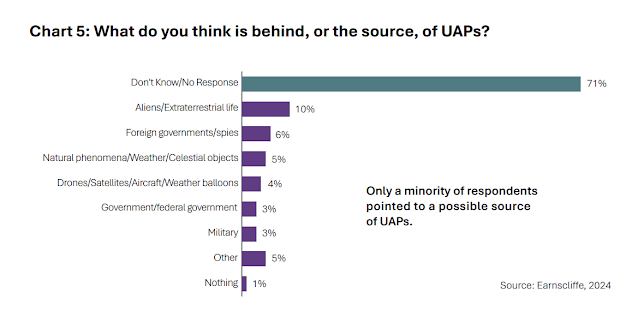
About 10% of Canadians believe UAP are alien spacecraft.
that Canadians are very thirsty for news about UAP. 67% are interested in stories
about UAP, and 62% specifically want to hear news about UAP in Canada.
Remarkably, Sky Canada
found that 27% of Canadians have seen a UAP at one point in their lives, and
11% in the past year, although only 9% of witnesses reported their sighting.
This is related to the finding that 38% of Canadians have no idea where to report
a UAP. 28% say they would report
a UAP sighting to police or military offices, although neither of these have
processes in place to deal with reports. Only 13% of Canadians would report a
UAP to a government office.
The survey found that in
general, Canadians want more government involvement with UAP issues. 55% want a
government agency for handling UAP reports, and 60% think the government should
keep Canadians informed about UAP. Furthermore, 49% of Canadians (vs 40%
against) think the government should allocate funding to investigate UAP.
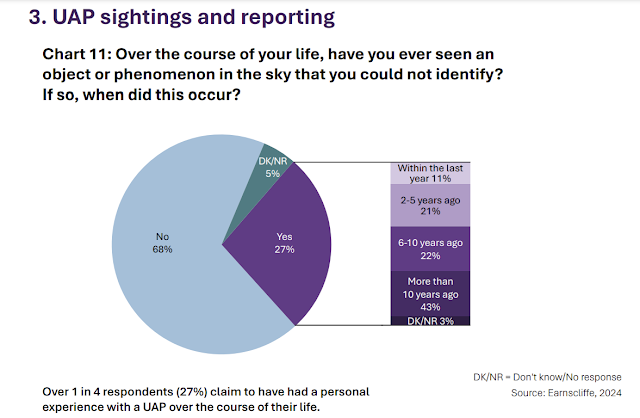
The most surprising finding was that 27% of Canadians say they’ve seen a UAP. That’s at odds with all other polls on the subject, which usually found about 10% of the population had seen UFOs or UAP. The most likely reason for the difference is the way in which polling was conducted by the outside agency, which used responses from “1,008 members from an online panel.” Sky Canada cautioned, therefore: “Note that the results of such self-selected participant surveys cannot be described
as statistically projectable to the entire Canadian population.”
We can hope that the
Canadian government will listen to Canadians and implement the recommendations
of the Sky Canada Project.
[NB: yes, they called them “aerial” instead of “anomalous.” Canada doesn’t have any underwater or space-based UAP.]
Labels: sky canada project UAP UFO study survey government OCSA science innovation 2024 preview report

Read the full article here