









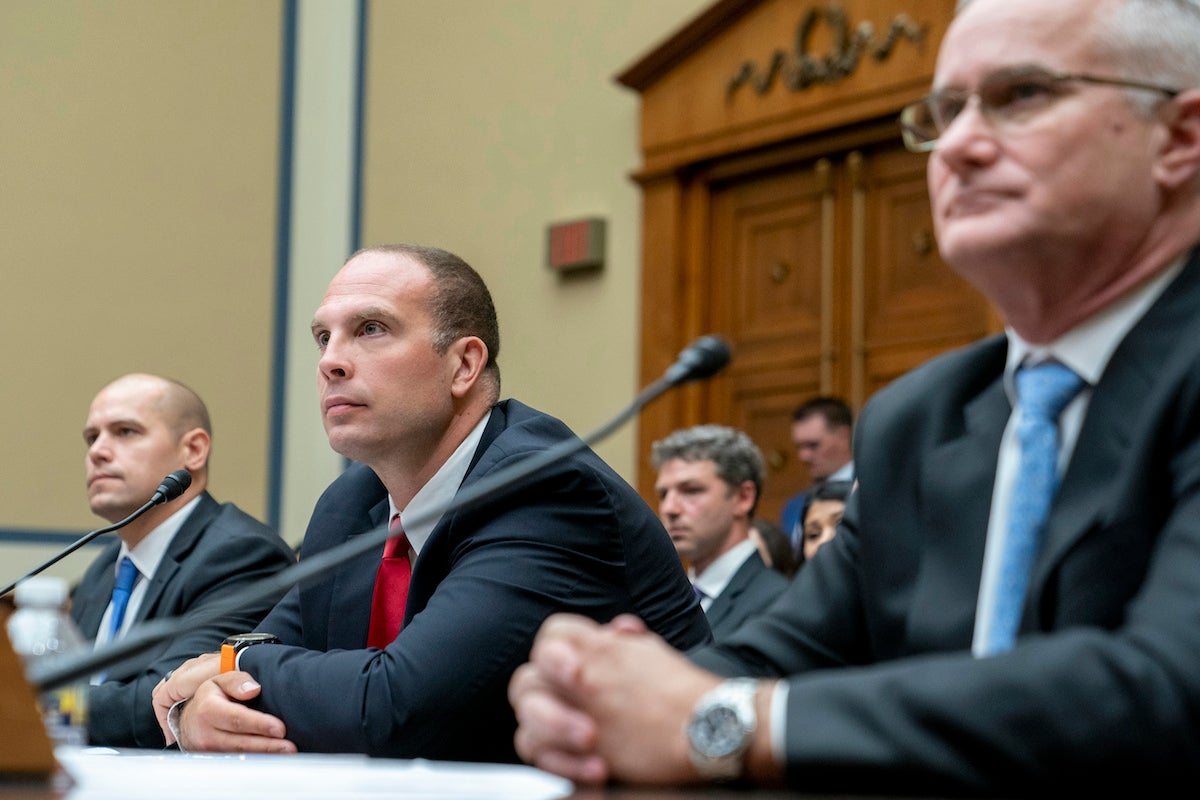
Both van Heijst, and Graves say their colleagues don’t talk about these sightings in public, because they are afraid of how it could damage their careers or reputation. van Heijst said that despite regular physical and mental wellness checks commercial pilots have to take, there is still a stigma against reporting these unknown objects in the sky.
“(If) a pilot comes forward saying, I saw a UFO, something that I cannot explain. He will get the stigma of: ‘ This guy, he saw little green men, he saw aliens.’”
Graves is working to change that: He founded a nonprofit called Americans for Safe Aerospace. The goal is to have a formal reporting system from credentialed pilots who can remain anonymous.
“We’re going to be looking to standardize the flow of information so that we can have more consistent reports. Right now, we’re handling these reports by hand, one by one.”
How to collect data that’s not just another grainy photo
The company Enigma Labs said they’ve created their own reporting system, in the form of a smartphone app where people can report things they see in the sky. People can send a picture, along with a record of what angle and direction the phone is pointed in. The app draws from existing databases to show known objects in the sky, like satellites and planets, overlaid on top of whatever the camera sees, explained journalist Alejandro Rojas, Enigma Labs’ head of content and research.
“When someone turns that on, they can say, ‘Oh, okay, it looks like I’m actually looking at a star or I’m looking at a satellite,” he said, adding that people often mistake Starlink satellites, or bright planets, for something more mysterious.
The app has been available for the past few months. He said they are getting 20 to 50 sightings a day, and their team evaluates each one. The goal is to build a database and train an algorithm to find the most credible sightings.
But, the app has its critics, such as astrophysicist Cecilia Levy.
“It’s a nice idea; I really don’t think that you’re gonna get that much useful data out of it,” she said. “Unless you have a Star Trek tricorder with you … then you can have everybody with their tricorder taking out literally every kind of data at once, but that’s not realistic.”
Levy consults for a nonprofit scientific organization, UAPx, which has a different approach. She, and collaborator and fellow astroparticle physicist Matthew Szydagis are both associate professors of physics at the University of Albany.
“What we want to do is try to avoid the situation of another single, grainy, low-quality photo or video of something unidentified in the sky,” Szydagis said.
Their plan is to go to supposed hotspots for these types of sightings with low light cameras, infrared cameras, and radiation detectors and take a lot of data over time. Szydagis said looking for these unknown objects in the sky is like trying to see a rare animal in the wild.
“You need cameras running 24/7. You don’t know, for example, when the animal is gonna walk by your trail cam, when is the deer going to … saunter by?”
They did one trip off the coast of California two years ago, and collected terabytes of data. They want to study this and publish papers that their colleagues can peer review, Levy said.
“We have to make this an international collaboration of scientists not including the drunk uncle that was on the bench at the park one night and saw something.”
NASA put together a panel on UAPs which recommended using both a high-tech science and citizen science model. They decided that NASA should make some way to collect better data on unknown things in the sky, that everyone can contribute to. But NASA should also help this effort, since they already know how to collect and process vast amounts of data.
Astrophysicist Federica Bianco from the University of Delaware is on the NASA panel. She said that aside from the technological issues, there’s also the issue of how to find and get through to people who don’t already have their minds made up one way or the other.
“The main obstacle I think in this field is going to be the intrinsic bias that we have about the topic whether it is as skeptics or as believers,” Bianco said. “Everybody that comes into this conversation kind of has a position.”
She said there are a lot of technological problems with data collection, but ultimately, the big challenge with bias is that it is a human problem.
Read the full article here